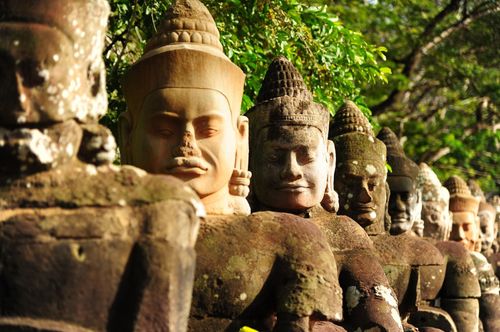
Cambodia’s history has been a story of rise and fall. The early days of Funan and Chen La were followed by the emergence of the powerful empire of Angkor, and in turn by a long period of decline ending in the loss of independence.
The Funan Empire
The first civilisation to appear in the region of present-day Cambodia was the Kingdom of Funan (1st–6th centuries AD), almost nothing of which survives today beyond the ruins of the supposed capital, Oc Eo, deep in the Mekong delta in (now Vietnamese territory).
Funan is though to have had extensive trade links acoss Southeast Asia, China, India, the Middle East and even as far as the Mediterranean and Rome. It made up part of the flourishing coastal trade network which girdled Asia at that time, from the region of Canton to the Red Sea.
Chen La: the rise of the Khmer people
By 500 Funan appears to have been in decline, as a new proto-Khmer state was developing in the region of present-day Phnom Penh. The inhabitants of this state, known to the Chinese annals as Chen La, spoke a Mon-Khmer language and were strongly influenced by Indian religious traditions. They may be regarded as the progenitors of the first authentically Cambodian state.
By around 800AD Chen La had developed into a fully-fledged kingdom, with its capital at Isanapura (modern-day Sambor Prei Kuk, near Kompong Thom). At the time Isanapura was, according to one contemporary commentator, “the most extensive complex of stone buildings in all Southeast Asia, built a century ahead of similar constructions in Java”.
The move inland
There is some uncertainty over what has been described as “Water Chen La”, which may have been a Mekong Delta successor to Funan, with its capital near present-day Phnom Penh, and “Land Chen La”, which lay further inland. By the 7th century “Land Chen La” seems to have eclipsed “Water Chen La” in importance as the centre of the kingdom moved northwestwards, towards the region which would eventually become Angkor.
By the 8th century “Land Chen La” was developing into an increasingly wealthy and centralised kingdom. Moreover, as the centre moved inland, away from the sea, it relied less on subsistence agriculture and trade, and more on manpower, irrigation technology and intensive rice production. In this way the foundations were gradually laid for the establishment of the Khmer Empire which would develop in the region of Angkor.
The empire of Angkor
The Angkorean period of Cambodian history is generally considered to have extended from AD 802 to 1431, although these dates should not be interpreted too literally – there were Khmers in the Angkor region before it became the capital, and Angkor was not completely deserted when the capital returned eastwards. Still, the six centuries between these two dates mark the peak of Cambodia’s power and influence in Southeast Asia, as well as the pinnacle of Khmer artistic and cultural achievement. Read more
14th–20th centuries
The country’s political and economic centre of gravity began a long but inexorable shift back from “Land Chen La” – that is, the Roluos-Angkor region at the head of the Tonlé Sap – to “Water Chen La” – the region around Phnom Penh, Lovek and Udong – in the mid-14th century. Expanding maritime trade and threats from Siam (Thailand) to the west both played a part.
The final move from Angkor seems to have taken place some time after 1432. Successive capitals were established, first at Lovek and then at Udong in the 15th and 17th centuries, both slightly to the north of Phnom Penh, and finally at Phnom Penh itself. Though smaller and less magnificent than Angkor, these new centres prospered, with international trade burgeoning, and distinct trading communities of Chinese, Malays, Portuguese, Spanish, Japanese and Arabs established in the area.
By the mid-19th century the once-mighty Khmer Empire had been reduced to a weakened rump state, dominated in the east by Vietnam and in the west by Siam. Then, in 1863, King Norodom was persuaded to accept the establishment of a French protectorate over Cambodia. As a consequence the country became a rather sleepy backwater under French protection.
The Indochina wars and the Khmer Rouge
After World War II, Cambodia quickly became caught up in the global power struggle between the USA and communism. Various complex factors played a part but essentially Cambodia was assisted by Vietnam in finally overthrowing the French, before it got mixed up in the Vietnam War.
A Khmer Communist insurgency, dubbed the “Khmer Rouge” (KR), emerged from the jungles of the remote northeast. Phnom Penh fell to the KR on 7 April 1975, fully two weeks before the North Vietnamese Army rolled into Saigon.
Almost the first order broadcast by the new regime, which called itself Democratic Kampuchea (DK), was the expulsion of the entire population of Phnom Penh on the pretext that a bombing raid was to be launched by the USA. In fact, KR policy was the complete ruralisation of Cambodian society – all cities, towns and major villages were to be emptied, and the population sent to work in the fields. This policy was implemented with extraordinary ruthlessness – even patients in operating theatres were turned out onto the street to fend for themselves. Those who could not do so or who argued were shot or beaten to death. Meanwhile, a search was instituted for all members of the former Lon Nol army, who were marked for execution. A similar fate awaited all “intellectuals”, from university professors and doctors to anybody who spoke a foreign language.
The brutal genocide, in which over 2 million Cambodians died, came to a sudden end in December 1978 when Vietnam sent its forces rolling across the Cambodian frontier, seizing Phnom Penh and forcing the discredited DK leadership to take refuge in camps along the Thai border.
Recovery and Modernisation
There followed a cynical period of nine years when the regime established by the Vietnamese was made an international pariah, while the remnants of the Khmer Rouge - waging an intermittent guerrilla war to regain power - received military and food aid from an unlikely collection of backers including China, the USA, Britain and Thailand. In September 1989 Vietnam finally withdrew its forces.
In May 1993, following UN-organised elections, Cambodia officially became a constitutional monarchy with King Sihanouk as head of state. The KR opted out of the elections, however, and this led to five more years of intermittent warfare during which the KR was gradually worn down. The KR leader, Pol Pot, died in 1998, while the last KR diehard, military leader Ta Mok, was captured near Anlong Veng in the north of Cambodia and taken to trial in Phnom Penh in early 1999. As a consequence, the power of the once greatly feared KR was broken for ever.
In 2005, a war-crimes tribunal to try surviving KR leaders finally received UN approval. Even so, political infighting and fear of just what such a trial might expose delayed the legal process until 2009, when Kaeng Kek Iew, better known as Duch, the former commandant of S21 interrogation centre, became the first KR leader to go on trial. He was convicted of genocide and crimes against humanity in 2011 and sentenced to life imprisonment. The trial of other senior KR leaders, all now in their dotage, continues. The most important defendants, former Brother No. 2 Nuon Chea and Brother No. 4 Ieng Sary, are quite likely to die of old age before a verdict can be reached. Meanwhile, prime minister Hun Sen remains in undisputed power, ruling with a very firm hand amid suggestions and accusations of corruption.
Nevertheless, in today’s Cambodia personal freedoms are greater, the press is more independent and there is more evidence of increasing prosperity now than at any time in the past 50 years. After their experience of unparalleled suffering in the preceding quarter-century, most Cambodians are relatively satisfied with the current order.
The dawn of Buddhism in Cambodia
Cambodia’s history has been a story of rise and fall. The early days of Funan and Chen La were followed by the emergence of the powerful empire of Angkor, and in turn by a long period of decline ending in the loss of independence.
The origins of the great city of Angkor
The foundation of the great city of Angkor is generally attributed to Jayavarman II, who's influence extended over all of present-day Cambodia as well as to neighbouring territories. He is considered the founder of the first unified Cambodian state. He made his capital at Hariharalaya, an area today marked by the Roluos complex of monuments about 13km (8 miles) southeast of Siem Reap, the oldest temple group in the Angkor region.
Cambodia historical timeline
Earliest times
100 BC–AD 500
Establishment of a flourishing trading state called Funan in the Mekong Delta.
500–700
A proto-Khmer state, known as Chen La, is established inland from Funan near the confluence of the Mekong and Sap rivers.
The Angkor period
802–50
Reign of Jayavarman II, who proclaims himself a god-king and begins the great work of moving the capital to Roluos near Angkor.
1113–50
Surayavarman II begins the construction of Angkor Wat.
1352–1430
The Siamese Kingdom of Ayutthaya sacks and pillages Angkor four times, taking away the court regalia and many prisoners.
1432
King Ponhea Yat abandons Angkor. Subsequently Lovek, to the north of Phnom Penh, becomes the
capital.
The French in Cambodia
1863
The French force King Norodom to sign a treaty making Cambodia a French protectorate.
1866
A new capital is established at Phnom Penh
1945
King Sihanouk declares Cambodian independence from France, with Japanese support.
1954
At the Geneva Conference, France formally confirms its withdrawal from Cambodia.
War and the Khmer Rouge
1965
Vietnam War escalates; Communist forces begin to seek sanctuary in eastern Cambodia.
1967
Pol Pot’s group of Cambodian Communists – dubbed “Khmer Rouge” by Sihanouk – launches an insurgency in the northwest.
1975
Cambodian "Year Zero". Khmer Rouge take Phnom Penh on 17 April; cities are immediately evacuated, and the country is cut off from the outside world. Brutal persecution of Buddhism.
1979
Vietnamese troops invade and overthrow Pol Pot regime. People’s Republic of Cambodia established.
Recent times
1993
General elections are held, supervised by the United Nations.
1998
Pol Pot dies in mysterious circumstances and the Khmer Rouge finally disintegrates.
2005
A war-crimes tribunal to try surviving Khmer Rouge leaders receives UN approval.
2009
Former S21 commander Duch is the first former Khmer Rouge leader to stand trial; tensions flare with Thailand over the border dispute at Preah Vihear.
2012
Duch is sentenced to life imprisonment for genocide and crimes against humanity; meanwhile, the trial of Ieng Sary, Nuon Chea and Khieu Samphan continues. Tensions over border dispute with Thailand remain high.