China’s extraordinary economic transformation has brought unprecedented prosperity to millions, with the country now the world’s second-largest economic power.
In 1992, Deng Xiaoping, who had gradually emerged as de facto leader of China after Mao’s death in 1976, embarked on a tour of southern China, visiting Guangzhou and the two special economic zones (SEZs) of Shenzhen and Zhuhai. Deng used the tour to repeat the rallying cry with which he had jump-started rural reforms in 1982, “To get rich is glorious.” Chinese needed to go into business “even more boldly” and “more quickly” to create a socialist market economy with Chinese characteristics.
A series of articles published in Shanghai’s Liberation Daily won over local elites, and before long the calls for economic liberalisation began to become orthodoxy nationwide.
A large proportion of China’s new business elite emerged during the chaotic years of the 1980s. Many of these people had been imprisoned under Mao but, following their release, seized the new opportunities created by Deng’s reforms.
The result has been an explosion of economic growth unparalleled in human history. China’s GDP growth has averaged more than 9 percent since Deng’s tour, and it is now reckoned to be the world’s second-largest economy. In 1985, foreign direct investment (FDI) inflows amounted to around US$2 billion, but by 2011 had exploded to around US$116 billion.
Meanwhile, China has become the world’s leading exporter, with a share of global exports at around 10 percent as of 2010. Significantly, it has also risen to become the world’s second largest importer, with Chinese imports seen as important enough to the US economy to warrant near-constant pressure on Beijing to revalue its currency.
Since the start of its opening and reform policy, China has carried out innumerable reforms that have collectively transformed its economy – and the restructure continues. Membership of the World Trade Organisation since 2001 has had a major impact, effectively opening up the country to foreign trade, and the world’s markets to Chinese manufactures.
Whatever the risks ahead, two decades of reforms have turned China into an economic powerhouse, with pundits variously predicting it will become the world’s largest economy anywhere between 2017 and 2030 – giving it some room to deal with the occasional and inevitable setback.
Many observers have called the relationship between China and the United States as the most important in the world. Inextricably linked, and incredibly powerful, the uneasy union is sometimes dubbed “G2” – the Group of Two.
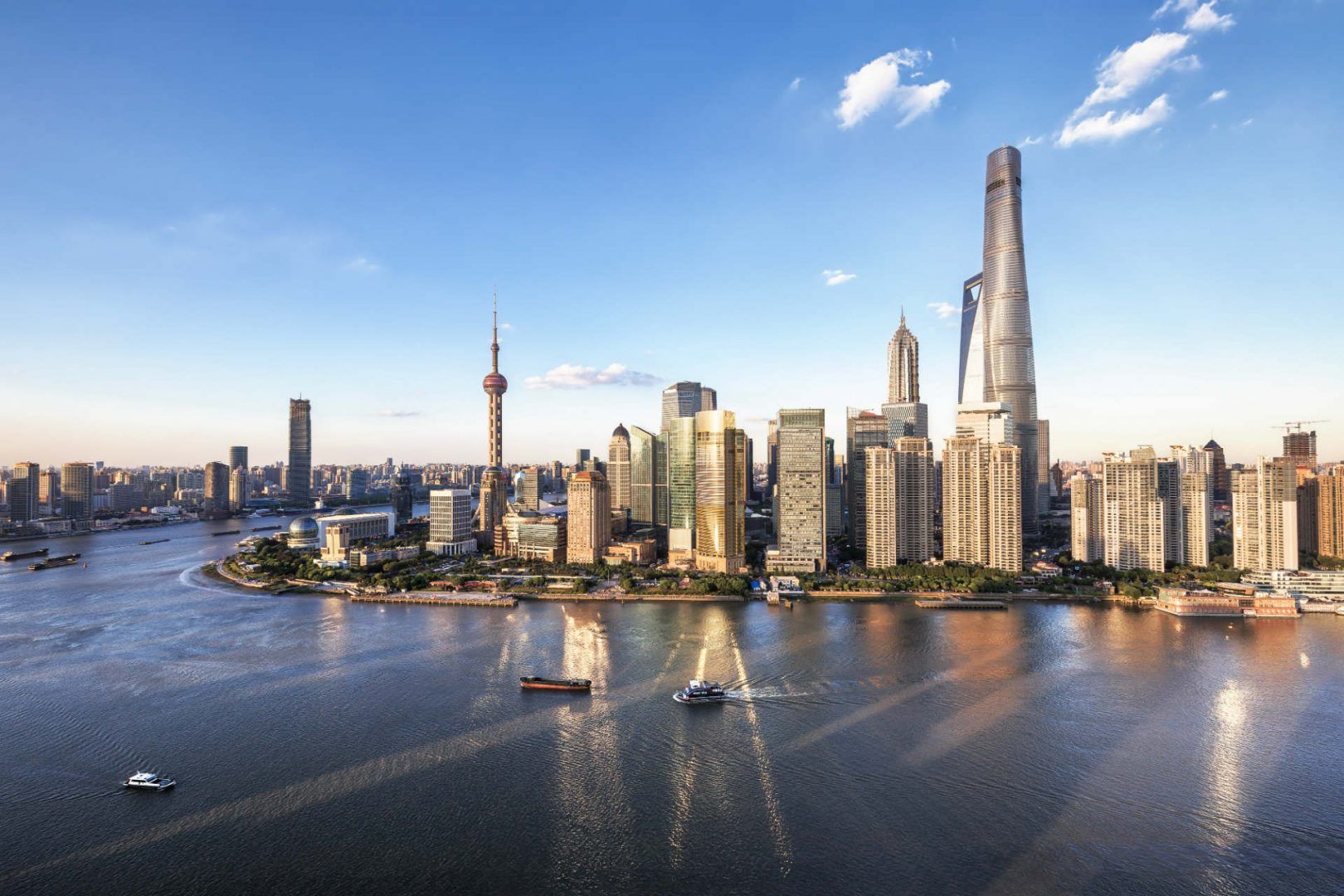
Lujiazui financial district, Shanghai.
Reform beginnings
China first started to turn its back on the collectivised economy it had practised since the Communist Revolution of 1949 when it began to dismantle the agricultural commune system in the 1970s, allowing “village enterprises” to be established. In the early 1980s, it became possible for individuals to set up one-person enterprises, or getihu, while by the mid-80s families were permitted to establish businesses with up to seven employees. At the same time the government began to allow foreign investment, in the form of joint ventures, with the opening of 14 coastal cities to outsiders, and – between 1980 and 1988 – the establishment of Special Economic Zones (SEZs) in Shenzhen and other places.
The SEZs were all essentially harbour interfaces with the outside world, which had long been kept at bay by the political Great Wall of the Mao era. Shenzhen was to become the most successful due to its proximity to that bastion of free trade and then British colony, Hong Kong.
Between 1978 and 1997, Hong Kong’s manufacturing businesses relocated over the border into the so-called Pearl River Delta (PRD) region. Hong Kong’s – and later Taiwan’s – investment in the PRD is such that it has become common to call the delta “the world’s workshop”, though in recent years Shanghai and the Yangzi River Delta (YRD) have been catching up.
For the first 10 years of China’s reforms, the PRD led China into the global economic order via foreign-invested firms in Shenzhen, Dongguan and Guangzhou, and is today a leading global source for electronics, electrical and electronic components, textiles and garments, shoes, toys, watches and clocks, and everything from clothes hangers to cocktail mixers. Accounting for just 0.4 percent of China’s total land area, the PRD is responsible for around 35 percent of the nation’s total trade (imports and exports).
Regional competition
The PRD may have spearheaded China’s economic rise, but in recent years it has been overtaken by competition from Shanghai and its Yangzi River Delta (YRD) hinterland, and also faces competition from the so-called Bohai Sea Economic Zone, which includes the municipalities of Beijing and Tianjin, and the city of Qingdao in Shandong province. Exports from the YRD have grown at an average of 41 percent per year since the beginning of the new millennium, and it now accounts for 34 percent of China’s total exports.
With annual GDP growth of 8.2 percent in 2011, it is calculated that Shanghai will overtake Hong Kong before 2020. However, the rise of the YRD and other regional economies is placing a strain on the availability of the migrant workers – the low-cost labour pool that has powered China’s growth over the past decade. Despite the fact that more than 150 million migrant workers have left their fields in the countryside to work in China’s factories, in the past few years there have been consistent reports of labour shortages, and that is leading to rising labour costs.
The World Bank estimates that China’s per-capita GDP, in terms of purchasing power parity, is only equal to that of Japan in the 1950s, when it was still a ravaged economy.
Recognising that growth has been overwhelmingly concentrated in four southeastern Chinese provinces – Guangdong, Fujian, Zhejiang and Jiangsu – in 2000 China adopted a Go West policy. The government has since spent more than Rmb 1 trillion on infrastructure development in the interior, including the 1,140km (710-mile) railway to Tibet and a vast network of fast, efficient roads. Growth rates have fared better than the national average since, though foreign firms have yet to show much enthusiasm for investing in these backward regions. For many manufacturers, despite massive government investment in transport infrastructure, much of China’s interior – home to some 700 million of the country’s population – is simply too far from any port to run an economically viable business.
The dirty work
Rising labour costs and the appreciation of the Chinese yuan against the US dollar are beginning to erode China’s price competitiveness as a source for cheap manufactured goods. China’s key exporting provinces have been reacting to this by shifting gears towards the production of higher-value products, such as cars, electronics and computer chips. In the meantime, manufacturers of the products that made the PRD rich are tending to relocate to Vietnam and India rather than China’s relatively undeveloped inland hinterland.
During the 2008 financial crisis, a wave of factory closures saw over 20 million migrant workers lose their jobs. Many owners simply left the country leaving workers without due wages. South China’s Dongguan has faced continuing difficulties with two major plants – toys and textiles – closing in 2011, repeating the familiar pattern of bosses fleeing owing millions of dollars in wages to angry workers.
China’s race to the future has been run at the expense of environmental degradation. This is a problem that even relatively leafy, park-endowed Hong Kong has to endure. The explosion of manufacturing in the PRD has led to a situation where, on a bad day, visibility can be so poor it is barely possible to see across the harbour.
But if Hong Kong bemoans its environmental woes, the situation elsewhere in China is far worse. The air, water and soil across much of China are heavily polluted by its industry. The food chain is threatened by heavy metals from factories and also overuse of pesticides and fertilisers by farmers. Pollution is a concern not only of the central government, which has to pick up a sizeable bill for environmental damage, but also those directly affected.
21st-century challenges
The reality is that, for all the talk of the coming China century, the rise of the world’s most populous nation is a far more complex phenomenon than many commentators give credit to. A visitor who touches down in cosmopolitan, spectacularly affluent Hong Kong, and travels on to any of the innumerable five-star hotels in Beijing or Shanghai, could be forgiven for thinking China has “arrived”. But lurking in the wings of China’s success story is a host of problems that mostly impact on those who have prospered less from the past two decades of meteoric growth.