Sur, the east coast, and the Wahiba Desert form one of Oman's most distinctive natural regions, combining a historic maritime town, rugged shoreline, and accessible sand dunes within a compact area. This contrast justifies allocating specific time in a multi-day itinerary rather than treating the route from Muscat as a simple transit leg.
The region offers clear, practical options: coastal drives and sea views near Sur, short walks or viewpoints along the shore, and straightforward desert camps in the Wahiba Sands for sunset, stargazing, and basic dune activities. Travelers usually slot it in as a 1-3 night section between Muscat and Oman's interior or south, using it to break up long drives with predictable, easy-to-plan stops.
Why visit Sur, the east coast, and the Wahiba Desert?
Sur, the east coast, and the Wahiba Desert offer an unusually close juxtaposition of traditional seafaring life, wild coastline, and accessible sand sea. Nowhere else in Oman can you watch wooden dhows being built by hand in the morning, explore wave-carved cliffs and hidden sea arches in the afternoon, then be standing atop high desert dunes by sunset.
The coast here feels raw and untamed, with blowholes, sinkholes, and viewpoints reached by short walks rather than long treks. Inland, the Wahiba's rolling sands allow for easy dune walks, sandboarding, and wide, dark skies ideal for stargazing.
The immediacy of these scenery shifts, from turquoise bays to blazing orange dunes, creates a sense of immersion in Oman's elemental landscapes that is hard to replicate elsewhere in the country.
Who are Sur, the east, and the Wahiba Desert best for?
You'll probably enjoy Sur, the east and the Wahiba Desert if you like combining gentle exploration with simple, clearly defined activities rather than full days of intense touring. Road trippers who appreciate short drives broken up by viewpoints, photo stops and easy walks tend to find this area rewarding.
Active travelers who prefer soft adventure over demanding hikes, and families looking for manageable outings and relaxed evenings outdoors, usually feel at ease here. Photographers who value strong contrasts of land- and seascapes, plus atmospheric sunrise or sunset scenes, often come away with varied shots rather than a single signature view.
You may prefer another destination if you are seeking long-distance trekking, technical hiking, or dense wildlife experiences, which are better found in Oman's mountain and canyon regions. Travelers who want a wide choice of upscale resorts, shopping, and dining may feel more at home in Muscat or Salalah.
If your ideal trip focuses on cooler temperatures and lush, green scenery, Oman's highlands will likely be a better match than this primarily coastal and desert segment.

Wahiba sands in Oman
How do Sur, the east coast, and the Wahiba Desert fit into an itinerary?
Sur, the east coast, and the Wahiba Desert usually sit in the middle of a wider Oman route, often linking Muscat with the interior or the south. They work best as a short, self-contained section of your itinerary, giving you 1-3 nights of steadier travel between busier city or mountain stages.
Many travelers drive out from Muscat, spend a night on or near the coast, then a night in or near the dunes before continuing inland or looping back to the capital. Distances are manageable, so you rarely need more than two overnight bases, though adding an extra night slows the pace further.
Including this region in your route introduces a natural pause, with shorter daily drives and a looser schedule that helps balance more concentrated sightseeing elsewhere in Oman.
How many days do you need?
Most travelers allow 2-3 days to experience Sur, the east coast, and the Wahiba Desert without rushing. This gives time for coastal viewpoints and short walks, plus at least one unhurried evening in the dunes for sunset and stargazing. Very short visits risk feeling like a fast drive-through rather than a distinct phase of the journey.
| Days | Recommended focus |
|---|---|
| 1 day | Express coastal drive with brief stops and a quick dune taster en route. |
| 2 days | One night on or near the coast, one afternoon or evening in the Wahiba Desert. |
| 3 days | Slow-paced circuit with extra coastal walks, viewpoints, and a full desert day. |
Additional days suit travelers who prefer slow travel, longer photo stops, or using the region as a gentle break between more intense mountain or city sections. A shorter visit works for those treating it mainly as a scenic link between bigger highlights.
Best region combinations
Sur, the east coast, and the Wahiba Desert combine naturally with Muscat, creating a loop that starts and ends in the capital. Travelers usually drive from Muscat down the coast to Sur and the dunes, then return inland or along the highway in about 3-4 hours, shifting from urban heritage to open coast and sandscapes.
Pairing this region with the Hajar Mountains works well for contrasting experiences. A common order is Muscat and the coast, then the Wahiba Desert, then on to Jebel Akhdar or Jebel Shams in 3-5 hours of driving spread over a day. The progression from sea to sand to high, cooler plateaus provides varied scenery without excessive daily distances.
Sur and the Wahiba Desert also fit into longer itineraries that continue south towards Duqm or Salalah. In this case, they act as a transitional section, breaking the journey with manageable coastal and desert stops before longer highway stretches.
When is the best time to visit Sur, the east, and the Wahiba Desert?
October to April is generally the best time to visit Oman for exploring Sur, the east and the Wahiba Desert. Warm but manageable daytime temperatures suit short coastal walks, dune excursions and desert camps, while clear skies favor sea views, sunsets and stargazing.
From May to September, heat and humidity rise sharply, especially along the coast and among the dunes. Activities are best planned for early morning or late afternoon, with long midday breaks in shaded camps or accommodations. Some travelers may prefer shorter desert stays and more time on air-conditioned scenic drives.
Haze, dust, and strong sun can still affect visibility and comfort, though snow is not a concern in this region. Crowds are usually light, but local holidays can bring heavier traffic around popular viewpoints, so flexible route planning is helpful.
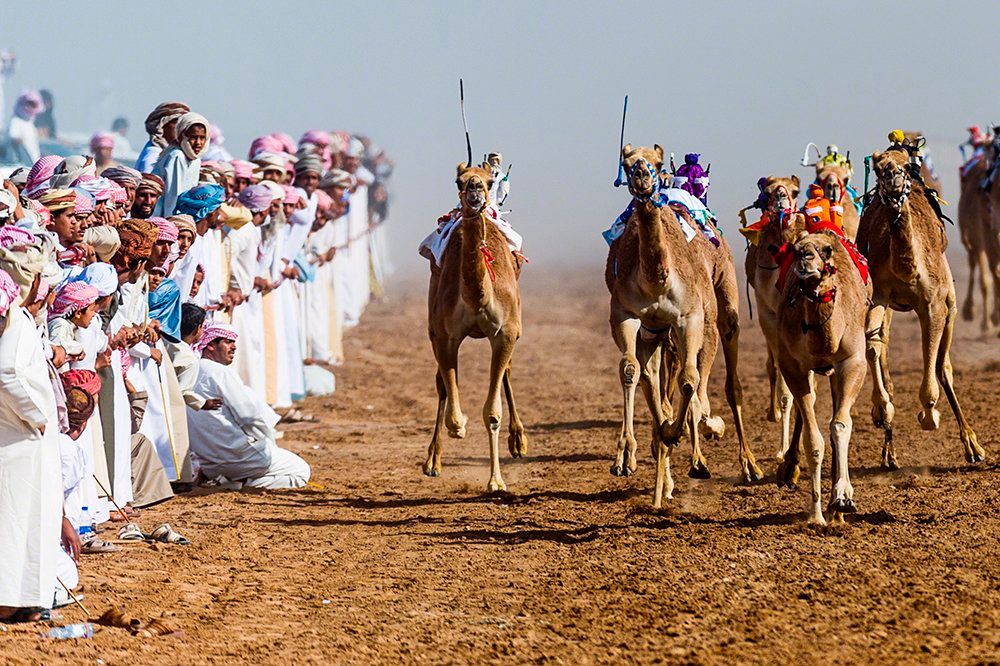
Camel racing, north of Wahiba Sands, Oman
Experiences to include in Sur, the east coast and the Wahiba Desert
The experiences below highlight the most rewarding ways to enjoy Sur, the east coast and the Wahiba Desert, focusing on relaxed outdoor time, scenic stops and gentle exploration rather than dense sightseeing.
Walk the cliffs and coves around Wadi Shab
Combine a boat hop and walk through Wadi Shab's canyon to its turquoise pools, then detour to coastal viewpoints near Tiwi. Allow half a day. Expect some rocky paths and heat. Best for reasonably fit travelers who enjoy short hikes and swimming.
Explore sea arches and bays near Ras Al Jinz
Use Ras Al Jinz as a base for short walks along the headlands towards Ras Al Hadd, where cliffs, small bays and sea arches reveal the wild Arabian Sea coast. Allow 2-3 hours. Ideal for photographers and those who enjoy breezy, low-effort walks.
Take a sunset dune walk in Wahiba Sands
From a desert camp in Wahiba Sands near Al Wasil, climb the nearby dunes for sunset views across one of the top attractions in Oman. Allow one to two hours for the walk and relaxed photo stops. Expect soft sand and short climbs, making the experience well suited to families and soft-adventure travelers.
Swim at Bimmah Sinkhole and coastal viewpoints
Stop at Bimmah Sinkhole in Hawiyat Najm Park for a quick swim beneath limestone walls, then continue to viewpoints along the coast between Fins and Tiwi. Allow 2-3 hours. Facilities are basic. Great for travelers wanting easy scenic stops on a driving day.
Stargaze from a Wahiba Desert camp
Spend a night at a camp in Wahiba Sands, away from Sur's lights, to enjoy clear desert skies and quiet dune edges. Allow an evening and early night, with optional pre-dawn viewing. Best for couples, families and photographers seeking a calm, atmospheric experience.
Follow the coastal road between Quriyat and Sur
Drive the coastal route between Quriyat and Sur, pausing at viewpoints above rocky inlets and beaches such as Fins Beach. Allow most of a day with picnic stops and short strolls only. Suits travelers who enjoy scenic drives more than structured activities.

Bimmah sinkhole, Oman © trabantos/Shutterstock
Planning Sur, the East and the Wahibah Desert with local expert tips
Eastern Oman lends itself to a journey with several distinct landscapes rather than a single base. Sur, the coast and the Wahibah Desert can sit along the same route, with travel specialists deciding where to spend each night and how to avoid repeatedly returning to Muscat between stops.
Where to stay in Sur, the east and the Wahiba Desert
Sur makes a practical coastal stop, particularly when the itinerary includes places nearby before turning inland. The Wahibah Desert calls for a different approach, with desert camps allowing you to stay among the dunes rather than visit briefly from a town outside the sands. Choosing between camp styles is only part of the decision.
Location affects how far you travel into the desert and how easily you can continue the following day. Your local expert can arrange the nights in a sequence that suits your priorities, rather than adding accommodation in every possible place.
If the desert stay matters more to you than extra time in Sur, for example, your expert can keep the coastal stop shorter and arrange an earlier arrival at camp, giving you more time in the dunes before evening.
How transportation can be arranged
The journey east from Muscat can follow the coast toward Sur before turning inland toward the Wahibah Desert, creating a natural circuit through this part of Oman. A private driver allows stops along the route to be selected according to your interests and available time. Reaching a desert camp may require a four wheel drive for the final section across the sands, so your local expert can arrange the correct vehicle or coordinate a meeting point with the camp.
The journey can then continue toward Nizwa and the interior rather than returning to Muscat, if that suits the wider route. If your dates allow only one desert night, your expert can time the departure from Sur and the camp transfer so you reach the dunes with time to enjoy the setting rather than arriving simply to sleep.


